
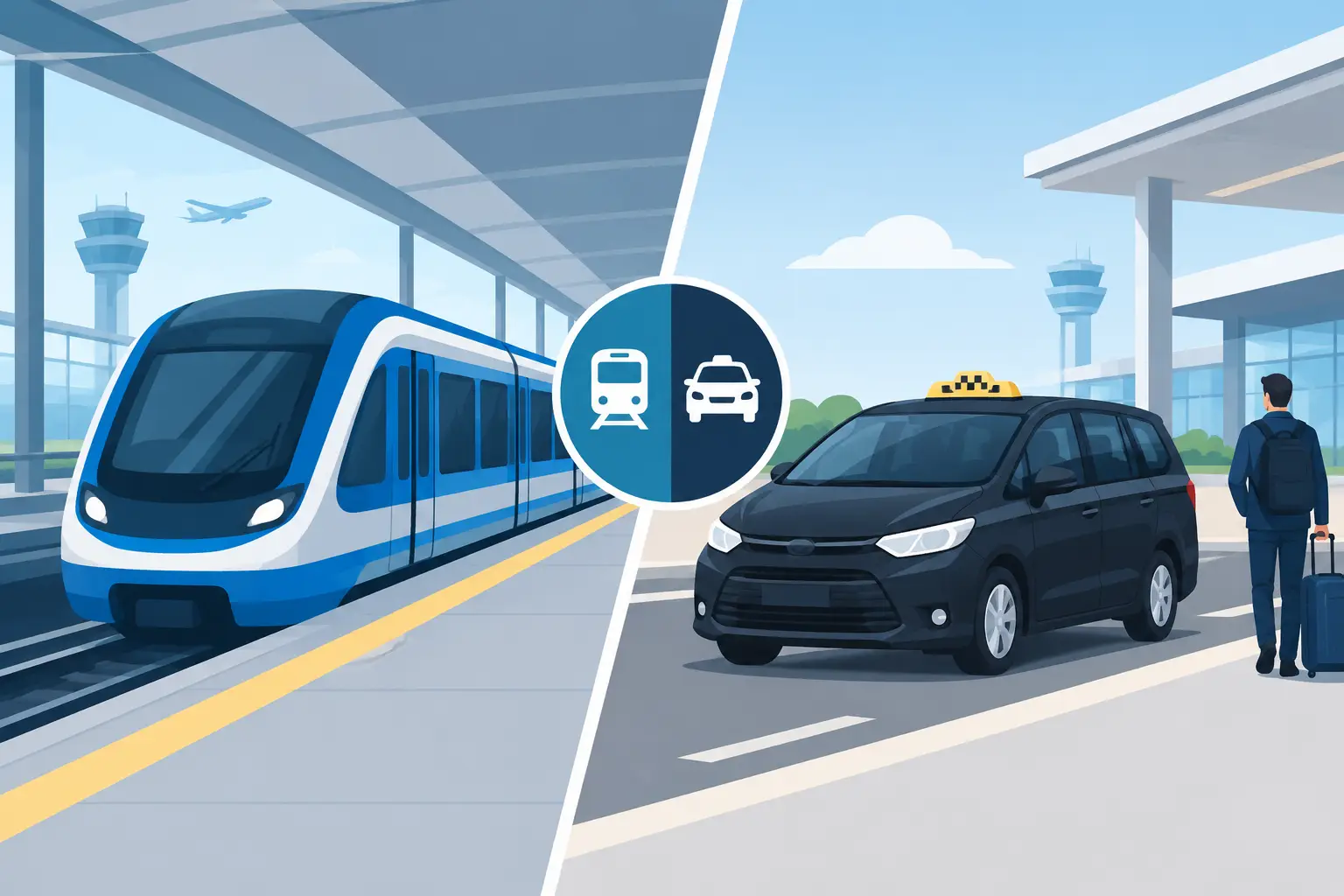
Airport Train Versus Minicab: Which Works Best?
A 05:30 airport departure changes the usual travel calculation. The airport train versus minicab choice is not simply about the lowest fare. It is about whether you can leave your front door on time, manage your luggage comfortably and arrive at the terminal without last-minute changes.
For some London airport journeys, rail is quick and sensible. For others, a pre-booked minicab offers better value once you factor in connections, luggage, children, unsociable hours and the number of people travelling. The right option depends on your route and how much certainty you need.
Airport train versus minicab: the key differences
An airport train works best when you live near a direct station, are travelling light and your flight falls within normal rail operating hours. Heathrow Express, the Elizabeth line, Gatwick Express and other rail routes can offer predictable journey times when services are running well. If you are travelling alone from central London with one small case, the train may be the straightforward choice.
A minicab is a pre-booked private-hire vehicle that collects you from an address and takes you to the terminal. There is no station transfer, platform change or need to carry bags up stairs. The journey is arranged around your collection time, rather than a published timetable.
The biggest practical difference is door-to-door travel. A train journey can look shorter on paper but may involve a walk, bus, Tube connection or another taxi at each end. For an airport transfer, the time from locking your front door to entering the terminal matters more than the time spent on the train itself.
Cost: compare the full journey, not one ticket
Rail fares vary by airport, time of travel and whether you book ahead. A single ticket may appear economical, especially for one person. However, add a taxi to the station, public transport across London, and a second connection at the airport, and the total can rise quickly.
A pre-booked minicab gives you an upfront fare before you travel. This is particularly useful when you are budgeting for a holiday or claiming a business journey. Unlike a metered black cab, the price is agreed in advance, so you are not watching the fare increase in heavy traffic.
The value of a minicab is often clearer for two or more passengers. Splitting one fixed fare can compare favourably with separate rail tickets, particularly for airport routes outside central London. Families should also consider the practical cost of handling several cases, pushchairs and tired children across stations.
Luggage and accessibility: where door-to-door service matters
Airports are designed for luggage, but many rail journeys are not. Busy platforms, escalators, lifts that are out of service and peak-time carriages can make a large suitcase difficult to manage. This is more noticeable after a long-haul flight, when you may also be dealing with jet lag and airport queues.
With a minicab, the driver collects you from the agreed address and assists with loading your luggage. You can select a suitable vehicle when booking, rather than hoping there is room once you are on board. This matters for groups, golf bags, bulky cases, prams or passengers with limited mobility.
For an arriving passenger, a meet-and-greet service can remove another point of uncertainty. Instead of working out where to find a station or taxi rank after landing, you have a clear collection arrangement and a driver who knows the flight details.
Timing, reliability and flight changes
Trains are not affected by road traffic, which is a genuine advantage on some routes. If a direct service is available and you are travelling at a busy road time, rail can offer a consistent timetable. Check planned engineering works before relying on it, especially at weekends, bank holidays and late at night.
A minicab journey requires sensible planning for London traffic, but a professional airport transfer is scheduled around your required arrival time. When you book in advance, you know who is collecting you, when they are due and what vehicle to expect. That is often more reassuring than trying to arrange transport on the day.
For airport collections, flight monitoring is valuable. Delayed flights, early arrivals and immigration queues are common, especially on international routes. A provider that monitors the flight can adjust the collection process around the actual landing time rather than leaving you to rebook from the arrivals hall.
Early-morning departures are another important factor. Rail services may not yet be running, may require several night-bus connections or may be less frequent than during the day. A pre-booked minicab can collect you directly from home at the time you need, without asking a friend or family member for a lift.
Privacy and comfort for business travellers
Business travellers often need to prepare for a meeting, take a call or simply arrive composed after a flight. A crowded train carriage is not always the right setting for that. A private vehicle gives you space for your laptop bag, samples or presentation materials, and avoids changes between services.
There is also a practical benefit when travelling with colleagues. One vehicle can keep the group together, simplify expense records and ensure everybody reaches the same terminal at the same time. An automated invoice and a confirmed fixed fare make administration more straightforward after the journey.
Which London airports favour rail or road?
Heathrow has strong rail connections, so passengers starting near a direct Elizabeth line or Heathrow Express station may find the train convenient. Yet Heathrow serves a wide catchment area, and a minicab remains useful for suburban addresses, large groups and flights outside rail hours.
Gatwick also has a rail station close to the terminal, making train travel attractive from certain parts of London. The decision changes if you need to cross the city with luggage, travel from an area with poor station access or depart before the first useful service.
Luton, Stansted, London City and Southend all have rail options, but each route can involve an additional shuttle, connection or walk depending on the terminal and your starting point. Check the complete journey rather than assuming an airport station means a simple transfer. A direct vehicle is often the calmer option when the route involves multiple stages.
When a minicab is the better choice
A minicab is usually the stronger option when you have a fixed flight deadline and any part of the public transport journey feels uncertain. It is particularly suitable if you are travelling with children, carrying more than one case, leaving before dawn, arriving late at night or travelling as a group.
It is also worth choosing a regulated operator rather than booking an unplanned ride at the last minute. Look for clear booking confirmation, licensed drivers, driver and vehicle details before collection, a defined payment process and a support team you can contact if plans change. These details are not extras when a missed flight is the risk.
TipTop Minicabs provides pre-booked airport transfers across London airports, with fixed fares, cash or card payment, flight monitoring and meet-and-greet available. The aim is simple: a professional and reliable collection that lets you focus on the journey ahead.
Make the choice before travel day
Start with your actual door-to-terminal journey time, then compare the full cost for everyone travelling. Check rail operating times and engineering works, consider how you will manage luggage, and allow a sensible margin for check-in, security and airport procedures. If rail gives you a direct, comfortable route, it can be an excellent option. If the journey includes several moving parts, a pre-booked minicab gives you one clear plan from home to terminal.
The best airport transfer is the one that leaves you with time to spare, your luggage under control and no need to improvise before a flight.
