
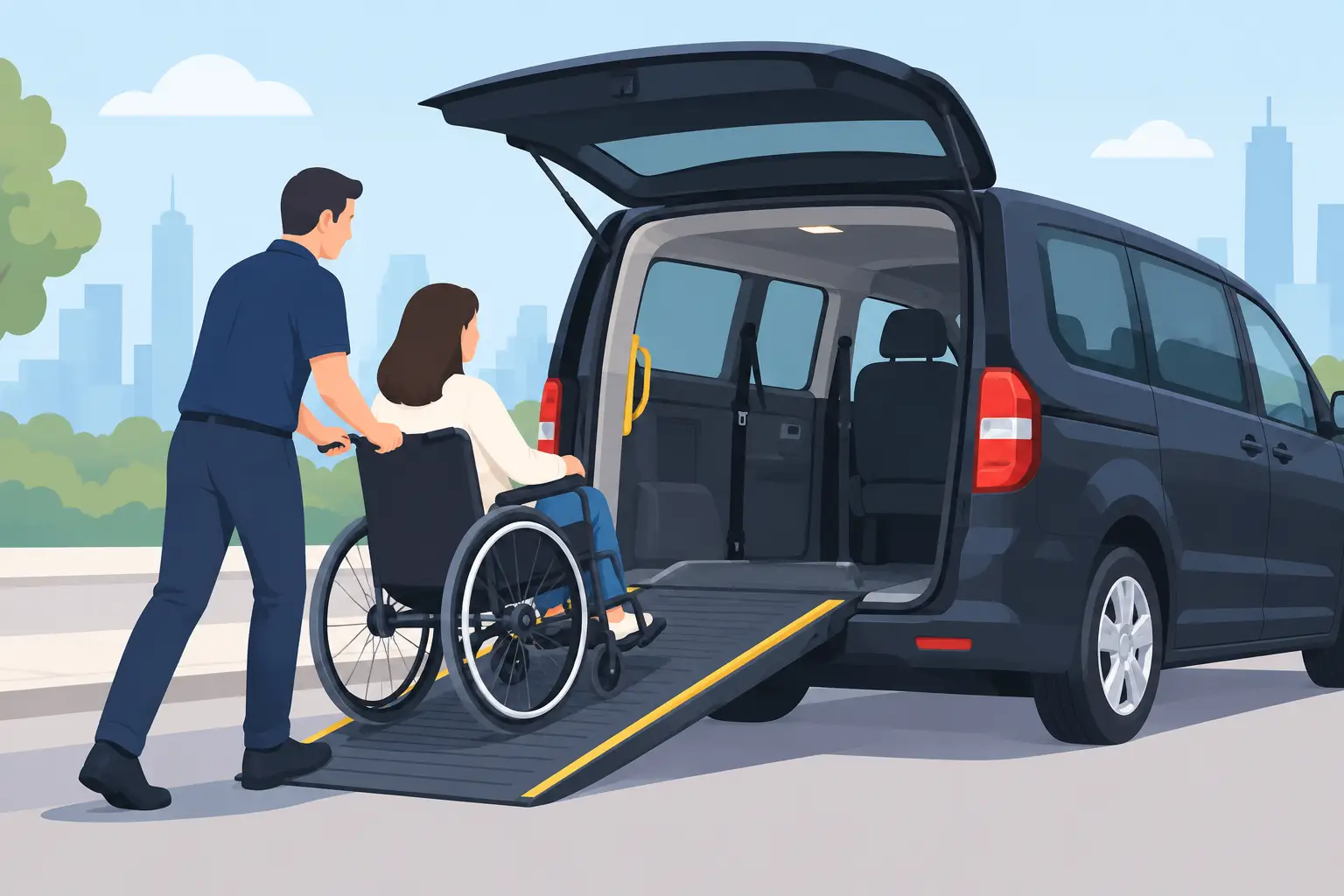
How to Arrange a Wheelchair Accessible Minicab
A standard car is not always suitable when a passenger needs to remain in their wheelchair during the journey. When you need to arrange a wheelchair accessible minicab, the most useful step is to book in advance and give clear, practical information about the passenger, wheelchair and route. That allows the operator to confirm whether the right vehicle is available, rather than leaving an essential journey to chance.
This matters even more for airport travel. A missed collection, unsuitable vehicle or unclear meeting point can turn a straightforward transfer into a stressful start or finish to a trip. A properly arranged private-hire booking gives you a confirmed collection time, an agreed fare and the chance to make sure the vehicle meets the passenger’s needs.
Book a wheelchair accessible minicab in advance
Wheelchair accessible vehicles are different from larger saloons or people carriers. A vehicle may have room for luggage and extra passengers but still not have a ramp, lift, suitable entry height or approved wheelchair restraints. For this reason, do not assume that requesting a large vehicle is enough.
Book as early as possible, particularly for early-morning airport collections, weekend journeys, bank holidays and peak travel dates. Advance notice gives the operator time to allocate a suitable wheelchair accessible vehicle and driver, confirm the journey details and advise if any part of the request needs adjusting.
If your plans are not final, it is still worth making contact early. You can check availability and understand the information required before your flight times, address or passenger numbers are confirmed. Leaving the request until the day of travel may limit the vehicles available.
Explain the passenger’s requirements clearly
The right booking depends on the individual passenger, not just the word “wheelchair”. Some customers travel in a folding manual chair and can transfer into a vehicle seat. Others need to remain seated in a powered wheelchair throughout the journey. These arrangements require different vehicles and different levels of space.
When you arrange a wheelchair accessible minicab, provide the wheelchair type, its approximate dimensions and whether it is folded or occupied during travel. If the chair is powered, mention its weight where possible. Also explain whether the passenger can transfer independently, needs a ramp or lift, travels with an assistance dog, or will be accompanied by a carer.
It is helpful to be specific about luggage too. Airport journeys can involve several cases, hand luggage, a pushchair or mobility equipment. A wheelchair accessible vehicle has to safely accommodate both the passenger and their belongings. Sharing this information in advance helps avoid a vehicle arriving with insufficient room.
Information to give when booking
A booking team can assess the journey more accurately when it has the following details:
- Collection date, time and full postcode, including any access instructions for flats, gated properties or hospitals.
- Destination, flight number and airline for airport transfers, or terminal and meeting point for an airport collection.
- Number of passengers, including carers or family members travelling together.
- Wheelchair type, dimensions, whether the passenger remains seated, and any equipment or assistance dog travelling.
- Number and size of cases, plus any return journey requirements.
Clear information protects the passenger as well as the driver. It means the operator can confirm the booking on the basis of the actual requirements, not an assumption made during a quick call or online form.
Check that the vehicle is suitable and confirmed
Ask the operator to confirm that the allocated vehicle is wheelchair accessible for your particular journey. This is more useful than a general assurance that accessible transport may be available. You should know whether the vehicle has the necessary ramp or lift, secure restraints and space for the wheelchair and luggage.
A suitable vehicle should allow the wheelchair to be secured correctly. Safety restraints are not an optional extra, and passengers should not be expected to travel without the equipment needed to keep the wheelchair stable. If a passenger transfers to a seat, ask whether the wheelchair can be stored safely for the full journey.
It is also sensible to ask about the driver’s arrival process. For a door-to-door transfer, confirm whether the driver will collect from outside the property or a practical nearby point if access is limited. At airports, agree the terminal, meeting location and what will happen if the flight is delayed.
Allow enough time for airport travel
A wheelchair accessible airport transfer can take a little longer at each end of the journey. Loading, securing the wheelchair and managing luggage should never be rushed. Build this into the collection time, especially when travelling to Heathrow, Gatwick, Luton, Stansted, London City or Southend.
For an outbound flight, plan for the airport’s recommended check-in time as well as the road journey. Consider traffic, terminal access, any stops needed on the way and the time required to unload safely. An early booking is often the simplest way to make the journey calmer for everyone involved.
For an airport pick-up, give the flight number rather than relying only on the scheduled landing time. Flight monitoring can help an operator follow changes to the arrival time, but passengers may still need time for passport control, baggage reclaim and airport assistance. Choose a collection time and meeting point that are realistic for the passenger’s needs.
If airport assistance has been arranged with the airline, keep the minicab collection details separate and clear. Airport assistance normally covers the journey through the terminal, while the private-hire vehicle needs its own agreed handover point. Confirm who will be travelling with the passenger and whether a carer will meet them at arrivals.
Confirm the fare and what it includes
Before booking, ask for an upfront price for the full journey. A fixed fare gives you a clearer picture of the cost than a metered journey, particularly where traffic or an extended airport route may affect travel time. Check whether the quoted fare includes parking, waiting time, meet and greet, extra pick-ups or any requested return trip.
The lowest quoted price is not always the best value if it does not cover the vehicle and support the passenger needs. The important comparison is whether the fare includes a suitable, confirmed vehicle, a professional licensed driver and a clear collection arrangement.
Choose the payment method that suits you, whether that is cash or card, and keep the booking confirmation. For business travel or carers arranging journeys on someone else’s behalf, an invoice can also make records easier to manage.
Check the booking details before travel day
Once the booking is accepted, read the confirmation carefully. The collection date, time, addresses, flight details, passenger count and wheelchair information should all be correct. If any detail is missing or unclear, contact the operator promptly rather than assuming it has been recorded.
It is useful to have the driver’s and vehicle’s details before collection where these are provided. This gives the passenger or family member reassurance that they are getting into the right vehicle, particularly at a busy airport or outside a large hospital.
If you are booking on behalf of somebody else, make sure the passenger has the information they need. Give them the operator’s contact number, the vehicle description if available, the driver’s name and the agreed collection point. A simple plan prevents confusion if the passenger does not use a smartphone or has limited access to messages.
TipTop Minicabs recommends sharing all mobility and luggage requirements at the time of booking so the journey can be assessed properly before confirmation.
On the day, keep communication simple
Have the passenger ready at the agreed collection time, but do not rush the safe loading and securing process. The driver should have the relevant wheelchair information already, although it is sensible to mention any last-minute change before setting off.
Keep your phone switched on in case the driver needs to confirm access to the property or airport meeting point. If there is a delay, a change to the flight, or the passenger is unable to travel, notify the operator as soon as possible. Early communication gives the best chance of adjusting the booking fairly and safely.
For a return trip, repeat the same checks. A wheelchair that was manageable on the outward journey may be accompanied by additional luggage on the way home, and airport meeting arrangements are often different from a home collection.
A well-planned accessible minicab journey is not about adding unnecessary steps. It is about giving the operator enough detail to send the right vehicle, at the right time, with the right arrangements in place. Book ahead, confirm the essentials and allow time for safe travel – then the airport transfer can begin with greater confidence.
